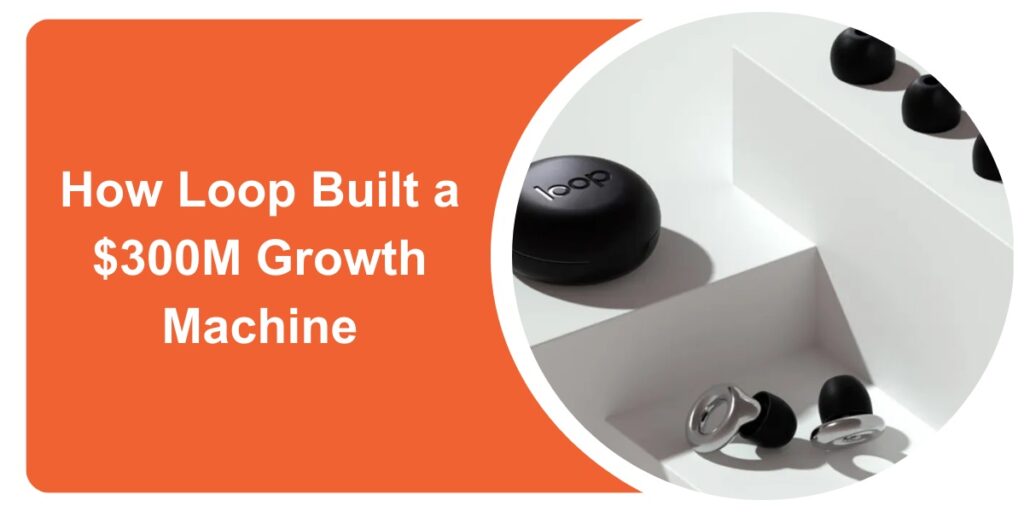
How does a company turn a $35 commodity into a $300 million global powerhouse?
I have spent time deconstructing the marketing ecosystems of the world’s fastest-growing DTC brands, and Loop is a masterclass in precision. In this Loop Earplugs Marketing Case Study, I am going beyond the aesthetic to show you the high-performance engine driving their growth.
From managing 500+ active Meta ads to mastering zero-party data via quiz funnels, I believe Loop has rewritten the playbook for 2026. I am breaking down the exact mechanics they use to dominate the feed, capture intent, and maximize customer lifetime value.
At a Glance: The Loop Growth Stack
Before I dive into the details, here is the high-level summary of the levers I identified in their strategy:
| Strategy Pillar | The “Why” |
| Creative Volume | Running 500+ ads to eliminate audience fatigue. |
| Quiz Funnels | Using data to solve the “Paradox of Choice.” |
| Persona Positioning | Selling identity-based solutions instead of features. |
| AOV Optimization | Engineering the cart for maximum transaction value. |
1. Flood the Feed from Every Angle
Loop does not rely on a single creative “winner.” At any given time, they run over 500 Facebook ads simultaneously to test different hooks, formats, and audiences. Their goal is not just to find an ad that works; it is to own the entire feed.
The Creative Mix Breakdown:
- Partnership Ads (Audience Hijacking): Loop collaborates with influencers and brands that already possess high trust. These ads feel native and credible because they are. They borrow existing authority instead of building it from scratch.
- UGC Creatives (Trust at Scale): User-generated content features real people in real scenarios. This lowers skepticism and increases conversions by making the brand feel organic rather than corporate.
- Feature and Benefit Ads: These are straightforward value propositions. They answer what the product does, why it is better, and who it is for.
- Lifestyle Visuals: Loop positions earplugs as fashion-forward accessories. High-quality, aesthetic imagery gives the brand a premium tech feel.
- Educational Breakdowns: They explain noise reduction levels ($SNR$ ratings) and why traditional foam plugs fail. Education builds the authority necessary to justify a premium price point.
Pro-Tip: If you are struggling to scale, stop looking for one “unicorn” ad. Create a matrix of these five styles to see which resonates with different psychological triggers in your audience.
2. The Quiz Funnel: Data First, Sales Second
This is where the real genius kicks in. Instead of sending all traffic to a product page, Loop often funnels visitors into a quiz with a discount incentive (usually 15% to 30%).
Why the Quiz is a Growth Lever:
- Zero-Party Data: It captures emails and specific user preferences immediately.
- Instant Segmentation: It identifies if the user is a sleeper, a concert-goer, or someone with sensory sensitivities.
- Personalized Recommendations: It removes the paradox of choice by telling the customer exactly which model (Quiet, Experience, or Engage) fits their life.
When scaling paid ads, data is your most valuable currency. The quiz transforms cold traffic into categorized leads for high-precision retargeting.
3. Engineering the Average Order Value (AOV)
Loop does not just want a sale; they want a high-value cart. Their direct-to-product pages are engineered with built-in “AOV Boosters” that trigger during the buying journey.
| Tactic | Implementation |
| Bundling | Offering “The Ultimate Collection” for different environments. |
| Cross-sells | Suggesting “Mute” inserts or carry cases at the “Add to Cart” stage. |
| Tiered Shipping | Setting free shipping thresholds that encourage adding one more small item. |
Every click is treated as an opportunity to increase the total transaction value, which allows Loop to outspend competitors on customer acquisition.
4. Apple-Level Design and Clarity
The Loop website uses a premium, tech-forward aesthetic. While the design is beautiful, the performance is driven by Clarity. Confusion is the silent killer of conversions. Loop’s product pages succeed because they:
- Clearly differentiate between models using comparison tables.
- Use macro photography to show fit and texture.
- Provide transparent technical specs for “power users” while keeping the main copy simple for casual buyers.
5. Persona-Based Positioning
This is the real scaling engine. Loop does not sell earplugs. They sell identity-based solutions. Their navigation speaks directly to specific personas:
- The Social Butterfly: For those who want to hear conversations but block background noise.
- The Frequent Flyer: For travelers seeking peace.
- The Parent: For managing the sensory overload of a loud household.
By targeting “The Parent” or “The Student” rather than just “someone who wants quiet,” Loop exponentially expands their Total Addressable Market (TAM). When a customer sees a category and thinks, “That is me,” the conversion battle is already won.
Summary: The Synchronized Growth Engine
Loop’s system works because every part of the machine talks to the others.
- They storm the feed to generate awareness.
- They capture data via quizzes to build a CRM.
- They personalize the journey based on persona.
- They maximize the cart through strategic upsells.
- They reinforce the brand with premium design.
Key Takeaways for Your Brand
- Creative Diversity: Scale your creative volume to avoid audience fatigue.
- Collect Data Early: Use lead magnets or quizzes to identify who your visitors are.
- Focus on AOV: High conversion rates are great, but high order values fund your growth.
- Identity Marketing: Stop selling “what” your product is and start selling “who” it is for.
What stands out most to me is that Loop didn’t simply launch a product; they engineered a system built on performance and deep customer personas. If you want to transform a basic commodity into a $300 million category leader, stop thinking like a seller and start thinking like a system builder. Don’t just create a product; build a performance-driven engine powered by clear customer personas, strong data, and scalable creative. That’s how you move from selling items to owning a category.

I’m a certified digital marketing expert with over 9 years of experience helping businesses grow through SEO, PPC, and content marketing. I focus on creating data-driven strategies that deliver measurable results and long-term growth.